The methodology I used to train every junior marketer
When I first led B2B marketing teams, I had a problem every marketing leader recognises: junior hires who understood tactics but not the system. They could write copy. They could set up campaigns. They could not explain how any of it connected to revenue.
My solution was not a training course or an expensive certification programme. It was HubSpot’s content library.
Not the product - the thinking. The inbound methodology. How to earn attention instead of buying it. How content creates demand. How the buyer’s journey shapes everything from the first touch to the closed deal. HubSpot had taken something that most B2B organisations struggled to articulate - the connection between marketing activity and business outcomes - and made it teachable. Nobody else had built anything as clear, as accessible, or as practical for explaining modern B2B marketing from first principles.
One letter, fifteen years
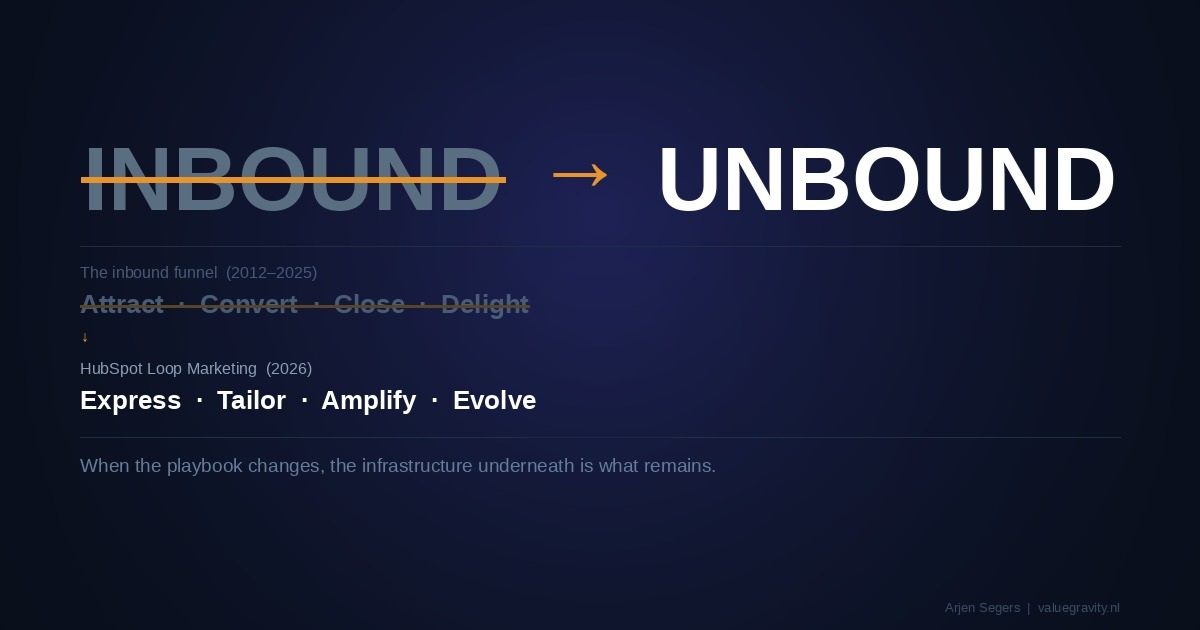
On April 6, 2026, HubSpot announced that its flagship conference INBOUND - held annually since 2012 - is being renamed to UNBOUND. The event returns to Boston for September 16-18, 2026, after a surprising detour to San Francisco last year.
The phonetic bridge between the names is deliberate. Close enough to signal continuity, different enough to signal a break.
HubSpot’s explanation is direct: growth no longer fits within a single framework or function. Their customers no longer just run marketing teams. They run revenue organisations spanning marketing, sales, service, and operations. The methodology that anchored the conference for fifteen years - attract, convert, close, delight - is too narrow for what modern go-to-market teams actually manage.
That is a significant statement from the company that invented the framework.
HubSpot already shipped the replacement
It would be easy to read this as cosmetic. A fresh coat of paint on a fifteen-year-old brand. It is not.
HubSpot has already built the replacement thinking. Earlier in 2026, they introduced Loop Marketing - a four-stage cyclical model designed to succeed the linear funnel that defined inbound. The stages - Express, Tailor, Amplify, Evolve - are built around continuous iteration rather than sequential conversion. Every marketing action feeds the next one. AI-driven personalisation replaces static segmentation. Multiple entry points replace the single-funnel assumption.
This matters because it tells you the conference rebrand is not the strategy. It is the last piece catching up to a strategy that was already in motion. HubSpot deprecated the inbound funnel in the product. They deprecated it in their marketing guidance. Now they are deprecating it in the event name.
The sequence is revealing: the company that built an entire category is systematically retiring it.
Why now
AI changed how buyers discover. The content-to-lead pipeline that powered inbound marketing - publish, rank, gate, nurture - depends on organic search traffic. That traffic is becoming less predictable. Buyers now find answers through AI-powered search and large language models before they ever click a link. HubSpot’s own blog, long considered the gold standard for B2B content marketing, was significantly impacted by Google algorithm changes in 2025. The very mechanics that inbound marketing was built on are shifting underneath it.
HubSpot outgrew its own category. The platform has evolved from marketing automation into what they now describe as an “agentic customer platform” - spanning CRM, sales, service, operations, and AI agents. The product already crossed the boundaries the conference name still implied.
Four visits from Europe
I attended INBOUND four times, flying in from the Netherlands each year. By then I had moved on from HubSpot as a customer. I kept coming anyway.
The conference had become something larger than the product or the methodology. Dharmesh Shah on stage, thinking out loud about culture and code and what makes companies worth building. Practitioners sharing what actually worked - not vendor-scripted success stories, but honest experiments and hard-won results. Running into Mike Rizzo and Jay Schwedelson - we somehow ended up picking the same hotels every year - people who are actively shaping how B2B marketing works in practice.
That community was always bigger than the product and bigger than the methodology. The event did not survive because of the inbound framework. It survived because of the people who gathered around it.
I was already surprised when they moved from Boston to San Francisco last year. That felt like a company searching for what comes next. The name change makes the intention explicit.
What this means for B2B leaders
HubSpot’s move is one data point, but it reflects a broader pattern worth paying attention to.
The methodology era - the period where you could adopt a single framework (inbound, ABM, product-led growth, demand gen) and build your entire go-to-market around it - is closing. Not because the frameworks were wrong, but because the environment they were designed for has fundamentally changed.
AI did not just add a new channel. It restructured how buyers find information, evaluate options, and engage with vendors. The linear playbooks that worked in a search-dominated, content-gated world need to evolve into something more adaptive, more integrated, and more dependent on connected infrastructure.
Go-to-market needs to be cross-functional by design, not by accident. The silo between marketing, sales, and customer success is not an organisational quirk. It is a structural risk. HubSpot’s own evolution - from marketing platform to customer platform - mirrors what its customers have been living through. The companies getting this right are building connected operating models, not bolting departments together after the fact.
The infrastructure underneath matters more than the playbook on top. This is the lesson that keeps repeating. Whether you run HubSpot, Marketo, Salesforce, or any other stack, the quality of your data, your governance, and your system integration determines what any methodology can actually deliver. A brilliant playbook on a fragmented foundation produces impressive reports and mediocre revenue.
The ability to adapt continuously is replacing the ability to execute a plan. HubSpot’s Loop Marketing is one expression of this principle, but it applies regardless of vendor. Static annual plans and rigid funnel stages are losing to teams that iterate weekly, test constantly, and treat their go-to-market as a system that learns. The organisations that struggle most are the ones still looking for the next single framework to follow.
Fifteen years is a good run
HubSpot built something rare. A company that educated its market - not as a marketing tactic (though it was brilliant marketing), but as a genuine contribution to how a profession thinks about its work.
The fact that they are willing to evolve past it - publicly, with a single-letter change that carries fifteen years of weight - says something about the intellectual honesty of the leadership team.
UNBOUND is in Boston this September. I might fly in one more time.
Not for the methodology. For the people. Same as always.
The Value Gravity™ Model maps where economic value accumulates in a marketing stack — and where it does not. It makes the infrastructure argument concrete: not which platforms you run, but where gravity pulls value in your specific configuration.